Tag Archives: myvector

MySQL 9.7 is out and the community wins 

May 2026 · 5 min read. Alkin Tezuysal

Cross blog from Oracle https://blogs.oracle.com/mysql/mysql-9-7-is-out-and-the-community-wins

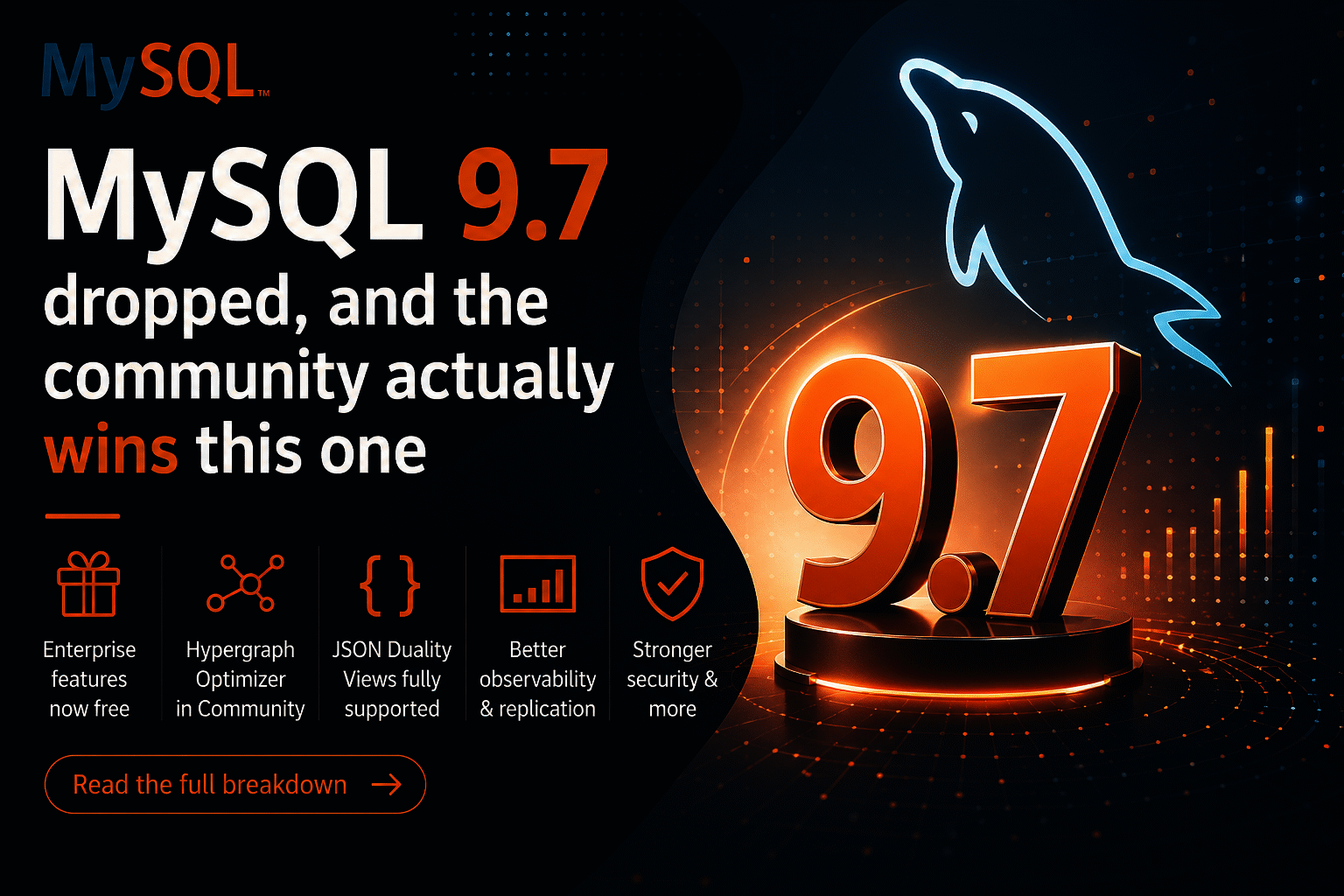
MySQL 9.7 came out on April 21 and I’ve been going through the release notes so you don’t have to. The short version: Oracle has made several previously Enterprise-only features available in the Community Edition; the Hypergraph Optimizer is now free for everyone; and if you’re still on MySQL 8.0, it has reached End-of-Life. Like right now. We’ll get to that.

Let’s go through what matters most.

First: MySQL 8.0 has reached End-of-Life

MySQL 8.0.46 shipped alongside 9.7, and it is the last 8.0 release. As of April 2026, 8.0 is officially End-of-Life. No more security patches. No more bug fixes. Oracle’s release notes now encourage users to upgrade to MySQL 8.4 LTS or 9.7.

If you’re on 8.0 in production, you’ve got two paths. MySQL 8.4 LTS is the safest, most conservative upgrade with a well-trodden migration path from 8.0. MySQL 9.7 is if you want all the new stuff, including everything in this post. Either way, the clock has run out on 8.0. It is strongly recommended to plan your upgrade soon.

Some Enterprise features available in the Community Edition

This is the headline. Oracle has moved five components from Enterprise Edition into Community Edition with this release. For self-hosted MySQL users, this is genuinely good news.

Four of them are replication components that now ship in Community Edition.

Replication Applier Metrics gives you real visibility into how your replica is processing events. Lag monitoring, throughput, the works. This was always the kind of thing you had to implement separately or access the Enterprise Edition.

Group Replication Flow Control Statistics now provides visibility into why your GR cluster is throttling. If you’ve ever stared at a slow cluster and had no idea what was happening under the hood, this one’s for you.

Group Replication Resource Manager lets you control how resources get allocated so replication stops starving your app workloads.

Group Replication Primary Election gives better observability into failover behavior during primary elections, which is exactly when you most need to know what’s going on.

And then there’s the Telemetry component, which is big if you’re running MySQL in a cloud-native setup. Metrics and traces can now flow to Prometheus, OpenTelemetry, and whatever else your observability stack includes. This was Enterprise-only until today.

The Hypergraph Optimizer is in Community Edition now

This is the one that stands out as particularly impactful.

Quick background: MySQL’s traditional query optimizer uses a left-deep tree approach to figure out join order. Works fine for simple queries, but with complex multi-table joins it can miss a lot of better execution plans. The Hypergraph Optimizer takes a completely different approach. It models the whole query as a hypergraph and uses dynamic programming to search a much bigger space of possible plans.

If you’ve got complex reporting queries or anything with a lot of joins, it’s worth turning on and seeing what happens.

To try it:

SET optimizer_switch=’hypergraph_optimizer=on’;

You can set it at session scope (great for testing), globally, persistently across restarts, or hint it on a per-query basis. Start with session scope on your actual slow queries before you go global. The optimizer is solid, but you don’t want surprises in production.

JSON Duality Views are now fully supported in Community

Previously, in Community Edition, you could define JSON Duality Views, but couldn’t do INSERTs, UPDATEs, or DELETEs through them. That was an Enterprise thing. This capability is now available in Community Edition. Full DML is now in Community.

They also added auto-increment support for duality view inserts, which means you can stop manually wiring up primary keys:

INSERT INTO orders_view

VALUES (‘{“customer_id”: 42, “product_id”: 7, “quantity”: 3}’);

The order_id gets generated automatically. Small change, but it removes a real friction point if you’ve been experimenting with duality views.

A few other things worth knowing

Password hashing got stronger.caching_sha2_password now supports PBKDF2 with SHA-512 storage format. Your existing clients don’t need to change anything since this is server-side only, but it makes stored hashes significantly harder to brute-force. Worth noting if you’re in a compliance-heavy environment like PCI-DSS or HIPAA.

Rolling upgrades just got easier. There’s a new variable called replica_allow_higher_version_source that lets a lower-version replica connect to a higher-version primary. Practically, this means you can upgrade your primary first, verify everything looks good, and then roll through your replicas at your own pace instead of taking the whole fleet down at once.

Container users, this one’s for you. MySQL now correctly reads cpuset cgroup limits to figure out how many CPUs are actually available to it. If you’d constrained MySQL to 4 CPUs in Kubernetes, it might have been sizing its thread pools against all 32 host CPUs anyway. That’s fixed.

OpenSSL got bumped to 3.5.5. Not exciting, but good hygiene.

What about Vector search?

A lot of people are asking about this, and the current status is that it is not yet generally available. Oracle is clearly building toward native vector search across the 9.x innovation releases, and you can see pieces of the foundation being put in place. But 9.7 isn’t the release where it lands as something you can use. It’s on the roadmap, it’s coming, the team is looking for feedback, and it is expected in future releases.  As some of you know, I’m especially interested in vector features as a maintainer of the MyVector project. We’ve had a couple of calls with the engineering team to collaborate on this subject. This might be an area for community contributions. Please stay tuned. 

So, should you upgrade?

Your situationWhat to do
Still on MySQL 8.0Upgrade. It’s EOL. Pick 8.4 LTS or 9.7.
On 8.4 LTS, happy where you areNothing urgent. Track 9.7 for the LTS landing.
Running Group ReplicationTry the new components.
Complex JOIN-heavy queriesBenchmark the Hypergraph Optimizer.
Running MySQL in KubernetesThe cgroup CPU fix alone might be worth it.
Excited about vector searchNot yet. Watch this space.


MySQL 9.7 is available at dev.mysql.com/downloads. If you end up benchmarking the Hypergraph Optimizer or trying the new replication components, share your results. The community learns from real-world numbers a lot more than from release notes. Drop them in the MySQL Community Forums or tag #MySQL97.

v1.26.3

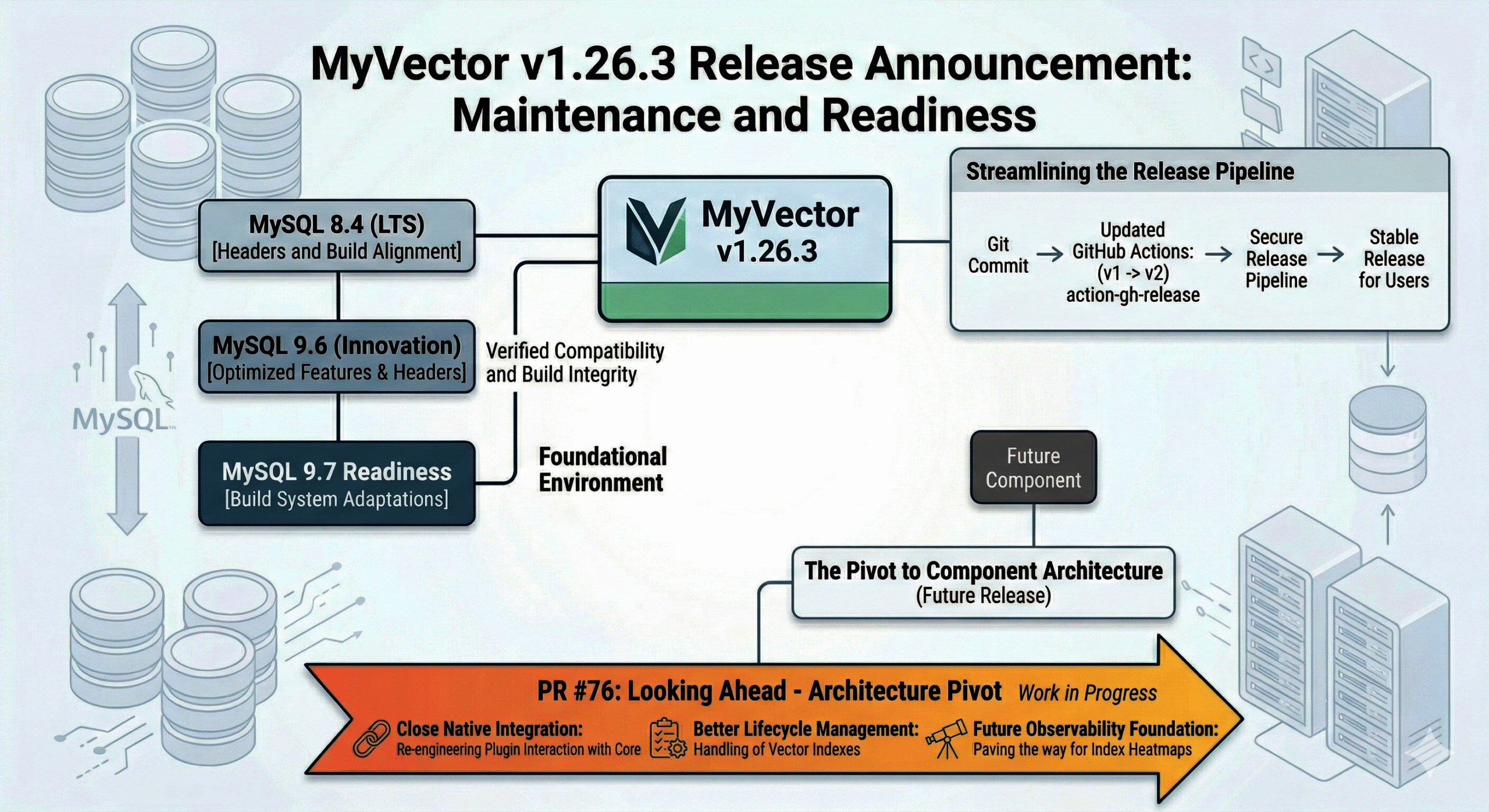
MyVector v1.26.3: Maintenance, CI, and Readiness for MySQL 9.7


In my recent series on Scoped Vector Search, we looked at the query patterns that make vector search a first-class citizen in MySQL. While the logic for those searches is now established, the infrastructure supporting them requires constant attention as the MySQL ecosystem moves toward its new release model.

Today, I’m announcing MyVector v1.26.3. This is a foundational release focused on environment compatibility and CI/CD robustness.

What’s in v1.26.3?

This release ensures that MyVector remains stable and buildable across the shifting landscape of MySQL Innovation and LTS releases.

  • MySQL 8.4 & 9.6 Compatibility: We’ve updated the component sources and build logic to align with the headers and requirements for MySQL 8.4 (LTS) and the 9.6 Innovation release.
  • Ready for 9.7: The build system has been adapted to handle the upcoming 9.7 release, ensuring that users can transition to the next Innovation branch without delay.
  • Modernized Release Workflow: We’ve bumped our GitHub Actions (softprops/action-gh-release) from v1 to v2. While invisible to the user, this ensures our release pipeline remains secure and compatible with the latest GitHub runner environments.

Think of v1.26.3 as the “maintenance and readiness” layer that ensures the high-performance HNSW search you rely on continues to compile and run perfectly on the newest versions of MySQL.

Looking Ahead: The Architecture Pivot (PR #76)

While v1.26.3 keeps us current, the real excitement is happening in the lab.

There is a fundamental architecture change currently in development under Component migration (8.4–9.6) and release workflow update.

Unlike the compatibility fixes in today’s release, PR #76 is a structural overhaul. We are re-engineering how the plugin interacts with the MySQL core. This shift is designed to move MyVector closer to a full Component Architecture, which will eventually offer better lifecycle management and even deeper integration with MySQL’s internal services.

This is a significant pivot in how MyVector is built, and it will set the stage for the next generation of vector performance and observability.

Summary

v1.26.3 is the stable, verified update you need for today’s MySQL 8.4/9.6 environments and tomorrow’s 9.7 upgrade. Meanwhile, work continues on the architectural evolution that will define the future of the project.

Scoped Vector Search with the MyVector Plugin for MySQL – Part I


Semantic Search with SQL Simplicity and Operational Control

Introduction

Vector search is redefining how we work with unstructured and semantic data. Until recently, integrating it into traditional relational databases like MySQL required external services, extra infrastructure, or awkward workarounds. That changes with the MyVector plugin — a native vector indexing and search extension purpose-built for MySQL.

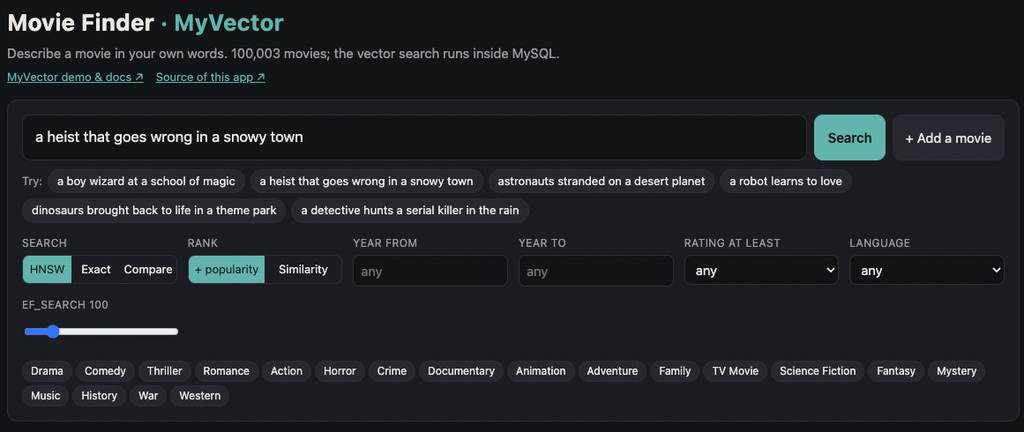
Whether you’re enhancing search for user-generated content, improving recommendation systems, or building AI-driven assistants, MyVector makes it possible to store, index, and search vector embeddings directly inside MySQL — with full support for SQL syntax, indexing, and filtering.

What Is MyVector?

The MyVector plugin adds native support for vector data types and approximate nearest neighbor (ANN) indexes in MySQL. It allows you to:

  • Define VECTOR(n) columns to store dense embeddings (e.g., 384-dim from BERT)
  • Index them using INDEX(column) VECTOR, which builds an HNSW-based structure
  • Run fast semantic queries using distance functions like L2_DISTANCE, COSINE_DISTANCE, and INNER_PRODUCT
  • Use full SQL syntax to filter, join, and paginate vector results alongside traditional columns

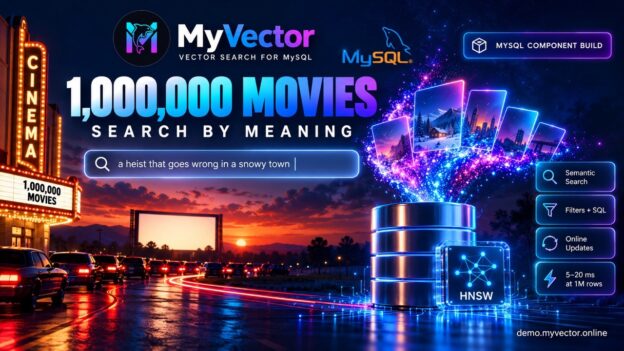
By leveraging HNSW, MyVector delivers millisecond-level ANN queries even with millions of rows — all from within MySQL.


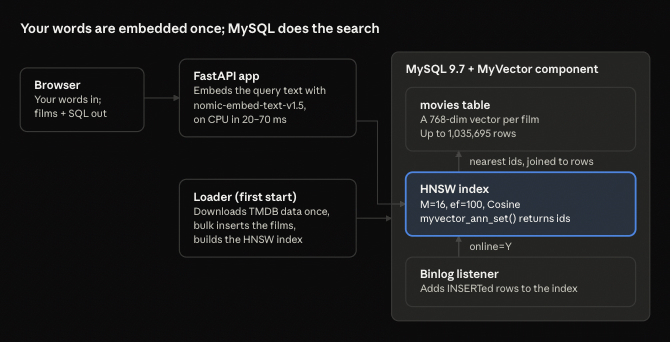
Most importantly, it integrates directly into your existing MySQL setup—there is no new stack, no sync jobs, and no third-party dependencies.


Scoped Vector Search: The Real-World Requirement

In most production applications, you rarely want to search across all data. You need to scope vector comparisons to a subset — a single user’s data, a tenant’s records, or a relevant tag.

MyVector makes this easy by combining vector operations with standard SQL filters.

Under the Hood: HNSW and Query Performance

MyVector uses the HNSW algorithm for vector indexing. HNSW constructs a multi-layered proximity graph that enables extremely fast approximate nearest neighbor search with high recall. Key properties:

  • Logarithmic traversal through layers reduces search time
  • Dynamic index support: you can insert/update/delete vectors and reindex as needed
  • Configurable parameters like M and ef_search allow tuning for performance vs. accuracy

Under the Hood: HNSW and Query Performance

MyVector uses the HNSW algorithm for vector indexing. HNSW constructs a multi-layered proximity graph that enables extremely fast approximate nearest neighbor search with high recall. Key properties:

  • Fast ANN queries without external services
  • Scoped filtering before vector comparison
  • Logarithmic traversal through layers reduces search time
  • Dynamic index support: you can insert/update/delete vectors and reindex as needed
  • Configurable parameters like M and ef_search allow tuning for performance vs. accuracy

What’s Next

This post introduces the foundational concept of scoped vector search using MyVector and HNSW. In Part II, we’ll walk through practical schema design patterns, embedding workflows, and hybrid search strategies that combine traditional full-text matching with deep semantic understanding — using nothing but SQL.