Tag Archives: ai

2025 Rewind and Thank You

I’m grateful to all my professional and personal networks for this year. It has been full of tears, sweat, and blood all over my face once again. Let’s not worry about that. I want to start with a big Thank You to all of you who made this year possible.

If I look back at what stood out in 2025, just before we hit 2026.

Oracle ACE Pro 

I was thrilled to be nominated to the Oracle ACE Program as an ACE Pro in April. This recognition opened doors to launch a technical blog series on vector search and AI integration with MySQL.

Project Antalya at Altinity, Inc. 

We announced native Iceberg catalog and Parquet support on S3 for ClickHouse. This pushes the boundaries of what’s possible with open lakehouse analytics.

MySQL MCP Server 

Introduced a lightweight, secure MySQL MCP server bridging relational databases and LLMs. Practical AI integration starts with safety and observability.

FOSDEM & MySQL’s 30th Birthday 

I have one of my busiest agendas in ten years. It includes the MySQL Devroom Committee, a talk, and an O’Reilly book signing for #mysqlcookbook4e. Additionally, there are 6 talks from Altinity.

O’Reilly Recognition 

After 50+ hours of flights for conferences, I came home to O’Reilly’s all-time recognition for the MySQL Cookbook. It was a moment I won’t forget.

Sailing While Working 

Once again, months at sea with salt, humidity, and wind were challenging. We handled tickets, RCAs, and meetings. We even recorded a podcast on ferry maneuvering. Born to sail, forced to work, making it work anyway.

I am immensely grateful to the #MySQL, #ClickHouse, and #opensource communities. Thank you to my co-authors Sveta Smirnova and Ibrar Ahmed. I also thank my nominator, Vinicius Grippa. I appreciate the Altinity team and every conference organizer who gave me a stage this year.

Recognition is an invitation to contribute more, not a finish line. Looking forward to more open-source collaboration in 2026.

If you’re passionate about open-source databases, MySQL, ClickHouse, or AI integration, or just want to connect, reach out.

#opensource #mysql #clickhouse #oracleacepro #ai #vectorsearch #sailing #LinkedInRewind #Coauthor #2025wrapped

Introducing Lightweight MySQL MCP Server: Secure AI Database Access


A lightweight, secure, and extensible MCP (Model Context Protocol) server for MySQL designed to bridge the gap between relational databases and large language models (LLMs).

I’m releasing a new open-source project: mysql-mcp-server, a lightweight server that connects MySQL to AI tools via the Model Context Protocol (MCP). It’s designed to make MySQL safely accessible to language models, structured, read-only, and fully auditable.

This project started out of a practical need: as LLMs become part of everyday development workflows, there’s growing interest in using them to explore database schemas, write queries, or inspect real data. But exposing production databases directly to AI tools is a risk, especially without guardrails.

mysql-mcp-server offers a simple, secure solution. It provides a minimal but powerful MCP server that speaks directly to MySQL, while enforcing safety, observability, and structure.

What it does

mysql-mcp-server allows tools that speak MC, such as Claude Desktop, to interact with MySQL in a controlled, read-only environment. It currently supports:

  • Listing databases, tables, and columns
  • Describing table schemas
  • Running parameterized SELECT queries with row limits
  • Introspecting indexes, views, triggers (optional tools)
  • Handling multiple connections through DSNs
  • Optional vector search support if using MyVector
  • Running as either a local MCP-compatible binary or a remote REST API server

By default, it rejects any unsafe operations such as INSERT, UPDATE, or DROP. The goal is to make the server safe enough to be used locally or in shared environments without unintended side effects.

Why this matters

As more developers, analysts, and teams adopt LLMs for querying and documentation, there’s a gap between conversational interfaces and real database systems. Model Context Protocol helps bridge that gap by defining a set of safe, predictable tools that LLMs can use.

mysql-mcp-server brings that model to MySQL in a way that respects production safety while enabling exploration, inspection, and prototyping. It’s helpful in local development, devops workflows, support diagnostics, and even hybrid RAG scenarios when paired with a vector index.

Getting started

You can run it with Docker:

docker run -e MYSQL_DSN='user:pass@tcp(mysql-host:3306)/' \
  -p 7788:7788 ghcr.io/askdba/mysql-mcp-server:latest

Or install via Homebrew:

brew install askdba/tap/mysql-mcp-server
mysql-mcp-server

Once running, you can connect any MCP-compatible client (like Claude Desktop) to the server and begin issuing structured queries.

Use cases

  • Developers inspecting unfamiliar databases during onboarding
  • Data teams writing and validating SQL queries with AI assistance
  • Local RAG applications using MySQL and vector search with MyVector
  • Support and SRE teams need read-only access for troubleshooting

Roadmap and contributions

This is an early release and still evolving. Planned additions include:

  • More granular introspection tools (e.g., constraints, stored procedures)
  • Connection pooling and config profiles
  • Structured logging and tracing
  • More examples for integrating with LLM environments

If you’re working on anything related to MySQL, open-source AI tooling, or database accessibility, I’d be glad to collaborate.

Learn more

If you have feedback, ideas, or want to contribute, the project is open and active. Pull requests, bug reports, and discussions are all welcome.

Scoped Vector Search with the MyVector Plugin for MySQL – Part I


Semantic Search with SQL Simplicity and Operational Control

Introduction

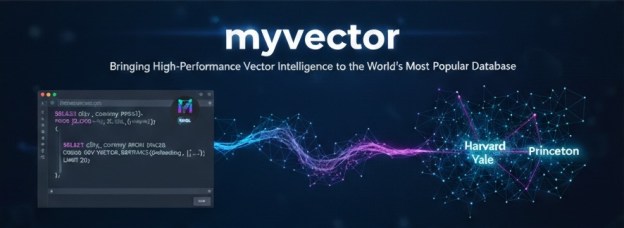
Vector search is redefining how we work with unstructured and semantic data. Until recently, integrating it into traditional relational databases like MySQL required external services, extra infrastructure, or awkward workarounds. That changes with the MyVector plugin — a native vector indexing and search extension purpose-built for MySQL.

Whether you’re enhancing search for user-generated content, improving recommendation systems, or building AI-driven assistants, MyVector makes it possible to store, index, and search vector embeddings directly inside MySQL — with full support for SQL syntax, indexing, and filtering.

What Is MyVector?

The MyVector plugin adds native support for vector data types and approximate nearest neighbor (ANN) indexes in MySQL. It allows you to:

  • Define VECTOR(n) columns to store dense embeddings (e.g., 384-dim from BERT)
  • Index them using INDEX(column) VECTOR, which builds an HNSW-based structure
  • Run fast semantic queries using distance functions like L2_DISTANCE, COSINE_DISTANCE, and INNER_PRODUCT
  • Use full SQL syntax to filter, join, and paginate vector results alongside traditional columns

By leveraging HNSW, MyVector delivers millisecond-level ANN queries even with millions of rows — all from within MySQL.


Most importantly, it integrates directly into your existing MySQL setup—there is no new stack, no sync jobs, and no third-party dependencies.


Scoped Vector Search: The Real-World Requirement

In most production applications, you rarely want to search across all data. You need to scope vector comparisons to a subset — a single user’s data, a tenant’s records, or a relevant tag.

MyVector makes this easy by combining vector operations with standard SQL filters.

Under the Hood: HNSW and Query Performance

MyVector uses the HNSW algorithm for vector indexing. HNSW constructs a multi-layered proximity graph that enables extremely fast approximate nearest neighbor search with high recall. Key properties:

  • Logarithmic traversal through layers reduces search time
  • Dynamic index support: you can insert/update/delete vectors and reindex as needed
  • Configurable parameters like M and ef_search allow tuning for performance vs. accuracy

Under the Hood: HNSW and Query Performance

MyVector uses the HNSW algorithm for vector indexing. HNSW constructs a multi-layered proximity graph that enables extremely fast approximate nearest neighbor search with high recall. Key properties:

  • Fast ANN queries without external services
  • Scoped filtering before vector comparison
  • Logarithmic traversal through layers reduces search time
  • Dynamic index support: you can insert/update/delete vectors and reindex as needed
  • Configurable parameters like M and ef_search allow tuning for performance vs. accuracy

What’s Next

This post introduces the foundational concept of scoped vector search using MyVector and HNSW. In Part II, we’ll walk through practical schema design patterns, embedding workflows, and hybrid search strategies that combine traditional full-text matching with deep semantic understanding — using nothing but SQL.

From MySQL to Oracle ACE Pro: A Milestone in My Database Journey

I’m incredibly honored to share some exciting news—I’ve been recognized as an Oracle ACE Pro by Oracle!

This recognition is deeply meaningful to me, not just as a personal milestone but as a reflection of the ongoing work I’ve poured into the database community for over three decades. It’s also a reminder of how powerful open collaboration, curiosity, and mentorship can be in shaping both a career and a community.

What Is the Oracle ACE Program?

For those unfamiliar, the Oracle ACE Program recognizes individuals who are not only technically skilled but also passionate about sharing their knowledge with the wider community. It celebrates those who contribute through blogging, speaking, writing, mentoring, and engaging in forums or user groups.

The program has multiple tiers: ACE Associate, Oracle ACE, ACE Pro, and ACE Director. Each level reflects a growing commitment to community contribution and leadership. Being named an Oracle ACE Pro places me among a diverse, global group of technologists who are actively shaping the future of Oracle technologies—and open-source ecosystems alongside them.

From MySQL to ACE: A Journey Rooted in Community

My journey with data began over three decades ago, and it’s taken me across continents, companies, and countless events. My early days were steeped in MySQL—performance tuning, operations, scaling architectures—and I quickly discovered that the greatest impact didn’t come from just solving problems, but from sharing the solutions.

Since then, my path has included global roles in consulting, support, and engineering leadership. I’ve had the opportunity to speak at international conferences, publish books like the MySQL Cookbook (4th Edition), and contribute to countless community efforts in the MySQL and opensource database ecosystems.

Recognition such as Most Influential in the Database Community (Redgate 100) and MySQL Rockstar have meant a lot—but being named an Oracle ACE Pro is especially meaningful. It represents a bridge between the worlds of open source and enterprise and affirms that collaboration across ecosystems is not only possible—it’s essential.

What This Recognition Means to Me

This isn’t just about a title or a badge. To me, becoming an Oracle ACE Pro is about continuing the mission—to share what I’ve learned, amplify others doing amazing work, and give back to the communities that have shaped my path.

I’ve always believed that technical excellence must go hand in hand with generosity. Whether it’s mentoring a young DBA, helping a team scale their architecture, or writing about real-world database design challenges, the point has never been visibility—it’s always been about value.

And that’s what this recognition reflects: not just what I’ve done, but what I hope to keep doing for the next generation of data professionals.

Looking Ahead

This milestone energizes me even more to keep contributing—not just within the Oracle ecosystem but across the open-source database space. I’ll continue speaking at events, writing, mentoring, and building resources that help engineers build better, faster, and more resilient systems.

I’m also excited about promoting hybrid data architectures combining MySQL, opensource, and cloud-native technologies. This is where the industry is heading, and I’m committed to helping folks navigate that evolving landscape with clarity and confidence.

Gratitude and Community

I want to thank Oracle for running a program that not only recognizes technical contributions, but also community-driven spirit. And a heartfelt thank you to the MySQL community, open-source contributors, and peers I’ve had the privilege of working alongside over the years.

You’ve all helped shape my thinking, my work, and my growth. I stand on the shoulders of a global community, and this milestone belongs to all of us.

Let’s Stay Connected

If you’re building something, learning something, or just curious about databases, I’d love to hear from you. Whether it’s MySQL performance, opensource design, or data architecture strategy, reach out. Let’s keep learning, building, and sharing—together.

And if you’re interested in becoming part of the Oracle ACE community, feel free to ping me. I’m always happy to share what I’ve learned and help others navigate that journey.


A Note About What’s Coming

As part of my role and responsibilities as an Oracle ACE Pro, I’ll be launching a new series of technical blog posts in the coming months. These will explore cutting-edge topics including:

AI/ML and LLMs (Large Language Models)

Vector Search and database integration

• Real-world use cases at the intersection of AI and relational databases

These areas are rapidly evolving, and I’m excited to share practical, hands-on insights on how they tie into modern data architecture—especially within the Oracle and open-source ecosystems.

Disclaimer: The views and opinions I’ll be sharing in upcoming posts are my own and do not necessarily reflect those of Oracle or any other organization. Content will be independent, community-driven, and based on real-world experience.

Stay tuned—and if you have specific questions or topics you’d like to see covered, feel free to reach out!

Thanks for reading—and here’s to the next chapter in our database story.