Tag Archives: ai/ml

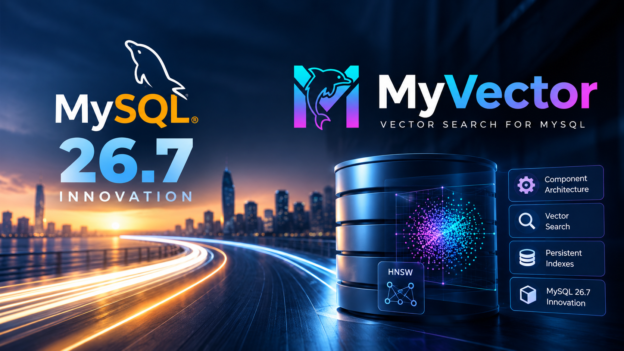
MyVector v1.26.9: Keeping Up With MySQL Innovation

MySQL 26.7 Innovation Support Lands


September 22, 2026 · ⁠GitHub Release

MySQL just changed the rules.

With MySQL 26.7, Oracle has moved to a new calendar-based versioning model for Innovation releases. For MyVector, that means one thing:

We need to keep up.

MyVector v1.26.9 adds MySQL 26.7 Innovation support, but the more interesting story is what happened beneath the surface.

This release puts the Component architecture introduced in v1.26.5 through a much more serious test.

From architecture to reliability

When we introduced the MySQL Component architecture in v1.26.5, the goal was straightforward: build MyVector in the direction MySQL itself is taking.

Now we are testing what happens when things don’t go perfectly.

v1.26.9 adds proper Component lifecycle testing, including installation, uninstallation, failed removal, and deinitialization rollback.

Because installing something is easy.

Installing, removing, failing, restarting, and recovering correctly is the real test.

HNSW gets harder to kill

There is also some important HNSW work in this release.

A number of failure paths around HNSW index creation and persistence have been fixed, including a case where an index build could crash mysqld.

That obviously isn’t acceptable.

We also fixed configuration handling so type=hnsw is correctly honored, and persistence failures are now surfaced instead of disappearing silently.

If MyVector cannot save an index, you should know about it.

Does it survive a restart?

This became an explicit test in v1.26.9.

It is one thing to create an index and run a vector search.

It is another thing to restart MySQL and have that index come back.

The new lifecycle tests verify that persisted indexes are actually reloaded from disk.

That is an important distinction as MyVector moves from an interesting MySQL extension toward something people can consider for real workloads.

The release process got better too

v1.26.9 also expands the testing and release pipeline around:

  • MySQL 26.7 compatibility
  • Component lifecycle
  • HNSW
  • Persistent indexes
  • Online updates
  • Stress testing
  • Stanford dataset smoke tests
  • Benchmark failure detection
  • Docker builds

What’s next?

The original MyVector idea hasn’t changed:

Why move your data to another database just because your application needs vector search?

The answer is becoming more interesting as MySQL evolves.

With MyVector, the goal is to bring:

SQL + transactional data + vector search + full-text search + AI workloads

into the same database environment.

MySQL 26.7 brings a new Innovation release.

MyVector 1.26.9 makes sure we’re ready to follow it.

v1.26.5 was about introducing the Component architecture.

v1.26.9 is about proving it.

Get MyVector

⁠MyVector v1.26.9

⁠GitHub Repository

⁠Documentation

MyVector is open source. Feedback, issues, benchmarks, and contributions are welcome.

Introducing Lightweight MySQL MCP Server: Secure AI Database Access


A lightweight, secure, and extensible MCP (Model Context Protocol) server for MySQL designed to bridge the gap between relational databases and large language models (LLMs).

I’m releasing a new open-source project: mysql-mcp-server, a lightweight server that connects MySQL to AI tools via the Model Context Protocol (MCP). It’s designed to make MySQL safely accessible to language models, structured, read-only, and fully auditable.

This project started out of a practical need: as LLMs become part of everyday development workflows, there’s growing interest in using them to explore database schemas, write queries, or inspect real data. But exposing production databases directly to AI tools is a risk, especially without guardrails.

mysql-mcp-server offers a simple, secure solution. It provides a minimal but powerful MCP server that speaks directly to MySQL, while enforcing safety, observability, and structure.

What it does

mysql-mcp-server allows tools that speak MC, such as Claude Desktop, to interact with MySQL in a controlled, read-only environment. It currently supports:

  • Listing databases, tables, and columns
  • Describing table schemas
  • Running parameterized SELECT queries with row limits
  • Introspecting indexes, views, triggers (optional tools)
  • Handling multiple connections through DSNs
  • Optional vector search support if using MyVector
  • Running as either a local MCP-compatible binary or a remote REST API server

By default, it rejects any unsafe operations such as INSERT, UPDATE, or DROP. The goal is to make the server safe enough to be used locally or in shared environments without unintended side effects.

Why this matters

As more developers, analysts, and teams adopt LLMs for querying and documentation, there’s a gap between conversational interfaces and real database systems. Model Context Protocol helps bridge that gap by defining a set of safe, predictable tools that LLMs can use.

mysql-mcp-server brings that model to MySQL in a way that respects production safety while enabling exploration, inspection, and prototyping. It’s helpful in local development, devops workflows, support diagnostics, and even hybrid RAG scenarios when paired with a vector index.

Getting started

You can run it with Docker:

docker run -e MYSQL_DSN='user:pass@tcp(mysql-host:3306)/' \
  -p 7788:7788 ghcr.io/askdba/mysql-mcp-server:latest

Or install via Homebrew:

brew install askdba/tap/mysql-mcp-server
mysql-mcp-server

Once running, you can connect any MCP-compatible client (like Claude Desktop) to the server and begin issuing structured queries.

Use cases

  • Developers inspecting unfamiliar databases during onboarding
  • Data teams writing and validating SQL queries with AI assistance
  • Local RAG applications using MySQL and vector search with MyVector
  • Support and SRE teams need read-only access for troubleshooting

Roadmap and contributions

This is an early release and still evolving. Planned additions include:

  • More granular introspection tools (e.g., constraints, stored procedures)
  • Connection pooling and config profiles
  • Structured logging and tracing
  • More examples for integrating with LLM environments

If you’re working on anything related to MySQL, open-source AI tooling, or database accessibility, I’d be glad to collaborate.

Learn more

If you have feedback, ideas, or want to contribute, the project is open and active. Pull requests, bug reports, and discussions are all welcome.